Saturday, 11 February 2012

Dusty roads and Health Centres


I am currently in the middle of a programme of midwifery skill drills for the Health centre Midwives.


Last Thursday, my VA Channa, and I set off by ferry to cross the Sekong and Mekong Rivers to Thala district at 7 am. We then had a one and a half hour motorbike journey North along rough brown roads to the Preah Romkel Health Centre on the West banks of the Mekong.


Three midwives were waiting for us and we set up our teaching session in the labour roomwhich has a beautiful view across the river.

First I tested them on the post partum haemorrhage drill they learnt last time – they remembered it very well. Next we went through breech birth with each midwife practicing the drill using the models sent out by kind people from the UK- Thank you again.


The midwives seem to enjoy this practical style of teaching- they say they have never learnt techniques to cope with problem breech births.


After the session we sat down to biscuits and a can of juice and now that they know me better they ask questions:

Can the soft lumps on a baby’s head at birth cause brain damage?

 Can I teach them how to suture after childbirth?

- I find this is a very positive step.


At midday we drove 3 Km further up the Mekong to the dolphin observation area but the dolphins were all a long way out or sleeping- not leaping out of the water in front of us anyway.

Next I was back on the motorbike for a further one and a half hours of potholes, dust and dodgy bridges.

We crossed back to Stung Treng on the ferry along with various livestock -this chicken had its legs tied together but kept flapping its wings too close to me for my liking.

I arrived home mid afternoon desperate for a shower and late siesta.

Monday, 6 February 2012

Stung Treng Airport


Yes Stung Treng has an Airport though when a plane last landed, I do not know.
Angela outside Airport building

Today it is a fairly quiet place awaiting its next role in the story of Cambodia. I like to go there on my bicycle for a ride in the evening before it goes dark. From the house it is about 20 mins ride and the same back by a circular route.
Control tower

I’m told it used to be the first place VSO Volunteers saw when they arrived in Stung Treng by plane as the roads used to be nonexistent or too dangerous to travel from Phnom Penh to Stung Treng.
The Runway

Friends in the Military visiting recently said it would still be possible to land large military planes there, I thought there was too much loose gravel about but apparently it’s OK.
Angela cycling down the runway

Most facilities are still there although on a small scale i.e. a little Control tower, small waiting room? Departure area etc.
Windsock

The airport resides at an elevation of 203 feet (62 m) above mean sea level. It has one runway designated 02/20 with an asphalt surface measuring 1,295 by 21 metres (4,249 × 69 ft).[1]

Follow this Link it looks nothing like that!:

http://www.flightstats.com/go/Airport/airportDetails.do?airportCode=TNX

AERODROME FACILITIES
Facility
Dimension,m
Surface
Strength
Runway
1300=(1170x29+130x20)
Bitumen
50 tones
RWY shoulder

Grass
N/A
RWY strips
1420x150
Grass
N/A
RWY End Safety Area
02
60x60
Grass
N/A
20
150x60
Grass
N/A
Taxiway
135x18
Bitumen
50 tones
50 tones
TWY shoulder
Grass
N/A
Apron
150x80 | 3 stands
Bitumen
50 tone


 Departure Lounge

Control tower

It's a nice place to go, a feeling of space and being quiet.
Will we ever see an airoplane there? Who knows possibly, a Helicopter.

Friday, 6 January 2012

Working In the Hospital

An Update of Angela’s work at the Hospital.
 All views expressed in the following article are our own and do not necessarily reflect the views of VSO or Stung Treng Hospital. Angela writes:
I was informed by the Doctor that babies born weighing less than 2 kg in Stung Treng will die within a week. I observed that there is no extra care or advice given to these babies or their mothers. They are just encouraged to breast feed on demand by the mother. Small babies of this weight are not strong enough to maintain their own body temperature or to demand enough food; they need a basic level of extra help.
A very poor women came into the Hospital maternity unit to deliver twins. Due to complications she had a caesarian section and then went to the mixed surgical ward for care which is where I found her two days later, not having been aware of her admittance or the birth of the twins. The ward was very crowded and the babies were asleep on the floor between two beds, a man with an infected foot was in the nearest bed. The woman and babies had received no care from a midwife although her wound had been redressed by the nurses. The baby boys were 1.9kg and 2kg at birth both looked dehydrated and were underfeeding. With the third year student midwives we discussed a plan of care including two hourly breast feeds (helped by the student midwives) and daily check and weighing of the babies. We also discussed Kangaroo care but that is difficult with twins after a caesarean section.

Mother Breastfeeding Twins in the surgical ward
Another VSO Volunteer and I gave the Grandmother some of our own money to buy food from the market so that they could all stay in a few more days. The hospital does not provide food or meals for the patients, food has to be prepared and brought in by the family if this is not possible due to no family present or ready money then it is a real problem for the patient to stay and pressures them to discharge from the Hospital early.
At five days old when the family went home the babies were gaining weight and appeared alert and healthy. They have a hard life ahead and I hope they will survive.
With the midwives and another VSO Volunteer we have developed a daily Baby check sheet for all babies along with a basic instruction sheet. This was accepted by the Chief midwife and Doctor so now in theory all babies get a daily basic check up; colour, feeding, bowels, urine, tone, breathing etc. The intention is that the situation regarding the twins not receiving attention should not happen again.

Breastfeeding Supported by Student Midwife
The students and some midwives do the check daily but I know that other midwives are maybe less diligent- but Rome wasn’t built in a Day!

Saturday, 17 December 2011

Just like chicken

Four of our VSO Volunteer friends have left Stung Treng recently and we had a few leaving dos before they went. I think this coincided with the 'cricket eating season' as at two of the meals plates of crickets appeared to be savoured and eaten. These were ordered by our Cambodian friends and I wanted to try them as they were not offered as anything unusual just another part of the celebration.

It's a lovely meal ,various dishes and the next one is? Crickets!!!

Since coming to Cambodia and travelling around looking at food stalls I had been wondering could I eat the various fried insects I had seen for sale? spiders,crickets and then there was the period when fried  frogs were everywhere.
Positioning the fingers to eat in one

So when offered the plate of fried crickets I barely hesitated and put the full creature in my mouth , chewed and swallowed- not bad , not a strong taste but yes if anything it tasted of chicken.I decided that rather than bite small pieces off the full body eg head ,I would go for the whole thing in one.
Come on Chris - share the plate
It amused me when one of my Kamai friends said no Chris do not eat the back legs they are sharp and will cut the inside of your stomache.

Getting a taste for them - reducing distance between plate and mouth!

 So the next one I held the backlegs and bit off the rest. There did'nt seem any point to this the legs were no sharper or crunchier than the rest.
Loverly!!!


So I am now looking forward to trying a bag of fried spiders which you can buy at one of the bus rest areas going to PP.
Bush Tucker trial? easy!!!


PS Would I /could I have eaten them without the Angkor Beer?
Just a quick slurp to wash  the bits down


Monday, 12 December 2011


Outside of work, Chris and I have found plenty of interesting things to do. We recently went to a Khmai wedding and enjoyed observing over two days the Buddhist ceremony in all its parts. It was my lovely Volunteer Assistant Channa getting married so we did a long bus journey to his beautiful bride’s house in another Province. There were maybe a hundred guest invited who were given food and drink over the two days of the ceremony. We took part in the hair cutting ceremony and observed many things and noted, as far as we could tell, there was no point at which they were pronounced man and wife!

We were told when at the celebration meal and dance in the evening they are accepted as being married.


VSO Volunteers enjoying Channa’s Wedding
 The cost of the wedding is met by the guests each putting money in their official wedding invitation envelope and then handing it in at the wedding at the appropriate time in the ceremony. We believe a minimum of $10 per person is expected and quite a bit more if you are well acquainted with the bride or groom.

Both Channa and Sovanns family made us feel really welcome and the experience was excellent.

One of many set piece ceremonies to make up the Wedding.
Next day, on the Sunday we travelled further North to the border with Thailand to visit the sacred site of the Temple of Preah Vihear which is an outstanding masterpiece of Khmer architecture and a UNESCO World Heritage site. This temple is the site of recent fighting between Thailand and Cambodia over ownership of the Temple and the conflict made World news and was followed by our family and friends back in the UK. The situation is still sensitive and the Cambodian soldiers seem to have a permanent presence amongst the Temple ruins along with their wives and children. It seemed strange to watch young children playing on the ancient tumbled down stones whilst the father/soldier laid his machine gun bullets out in a long line to clean and oil them in the sun, and the tourists gazed at the ruins.

Chris at the entrance to the first of four temples

Chris is busy teaching English at the local university and also working at a local NGO helping them with their work running an Orphanage amongst other things.

Sunday, 30 October 2011

More about Pchum Ben

Sorry we have not posted a blog item recently we have been busy but also we haven't had a camera for a while as when we were out one dark moonless evening Angela cycled into a ditch and she went underwater along with her bike and handbag.She was OK once I hauled the bike off her and pulled her out of the ditch but she had a scratch that went infected with the water, this cleared up with antibiotic cream.Anyway the camera and mobile phone filled with water and dont work anymore.

We mentioned the gongs and chanting that went on during Pchum Ben ón our last post.


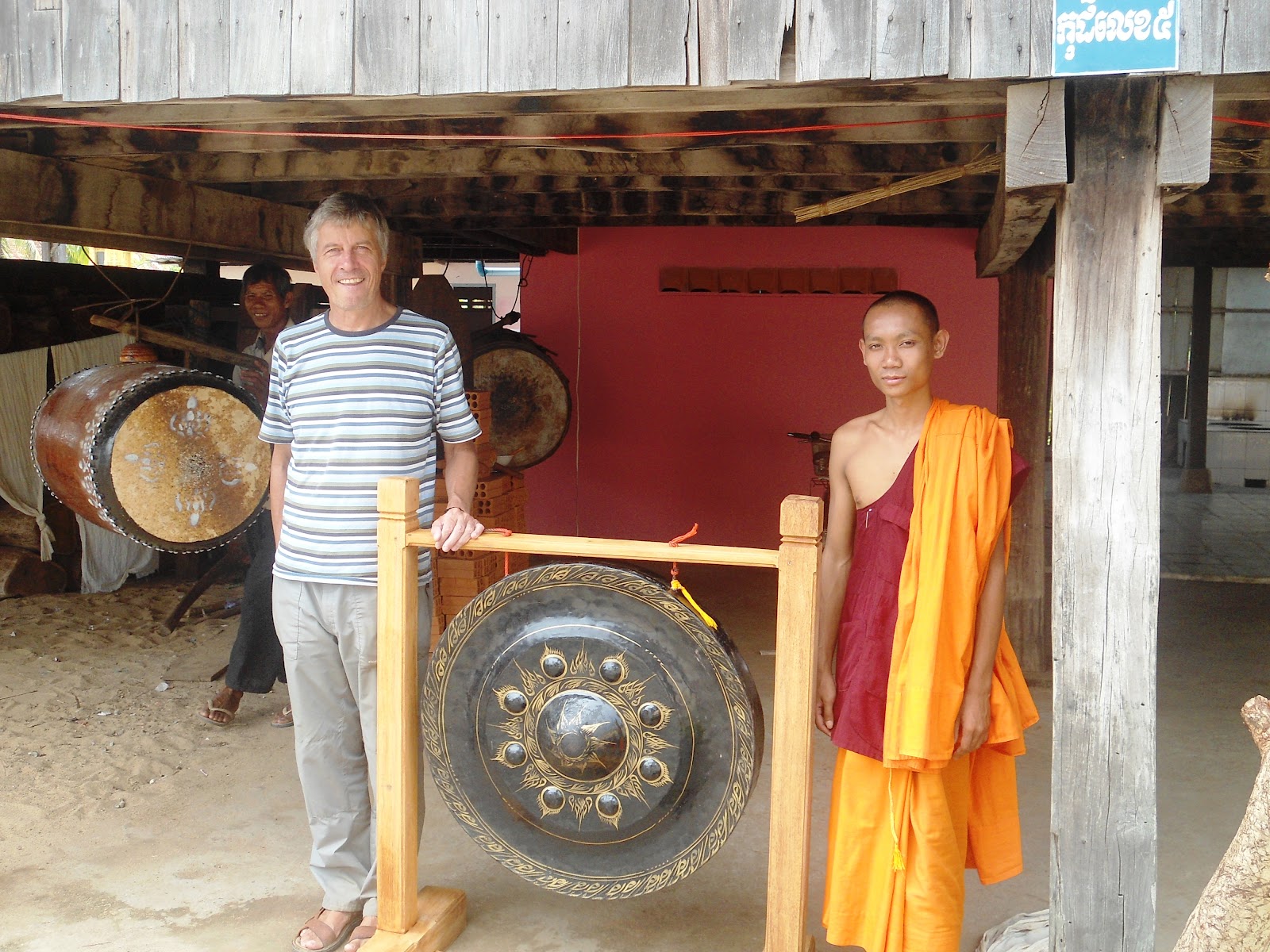
A tour around the local Pagoda Wat Leu identified an impressive array of huge drums and gongs  responsible for the sounds including a large unexploded bomb converted into a gong. Not sure which country would like to claim responsibility for this but as usual the monks waste nothing.

Pchum Ben is one of the most important holidays in Cambodia where Buddhism is the state religion and it is celebrated at Pagodas across Cambodia. I do not fully understand the ceremony and I can only offer the following information I have read and observed, apologies if some of it is wrong etc.
We live opposite a Pagoda so we are well aware of any ceremonies taking place and this particular one for feeding the spirits of the damned is not for late risers. The Pagoda loudspeakers begin their call in the 4 am blackness reminding Buddhists to make offerings and by the time the sun rises the ceremony is over and the ground littered with glutinous balls of rice. This is nourishment for the spirits of the damned and the damned only come out during the holiday and only at dark.
The call is repeated in the early morning each day of Pchum Ben which lasts for the first 15 days of the Khmer lunar month of Photrabot. This year the holiday began Sept 24 and ended Oct 8.
Before the rice balls are thrown to the ground in the ceremony, they are blessed and carried three times around the pagodas inner temple. Offerings are also made to the spirits of relatives and spirits without living relatives with celebrants bringing meals for monks later in the day.
Such offerings allow individuals to acquire merit; if anyone is grateful to their dead parents or others and in return does good to them they will receive merit. The offerings can also go to feed the dead who have been reborn in non human form such as small insect’s even ants.
It is believed that if you do not go to the pagoda to offer food to the monks and your dead cannot see you, you will be cursed.
During this time we went into the Pagodas grounds to have a look round and also to see the drums and gongs that awaken us early every morning. Although the English language class I teach is only small there are two students who are monks at the Pagoda and when I visit they always come over for a chat and to show us around.
Chris , Gong and Song the monk

The final evening there is a big celebration in the evening and when it is dark to say farwell to the spirits as they leave. Bamboo boats are floated on the river with lit candles and naked flames on bamboo torches as the boats are carried away by the strong river current at this time of year. I was very interested to see the boats being built out of nothing more than split bamboo and strips of rubber.
Bamboo boat being built in the Pagoda grounds

 The people making them were very skilled in making a large lattice structure very light and strong out of nothing more than slivers of bamboo. The candles were put in condensed milk tins and nailed to the boat.
The sides for the boat being made out of slivers of bamboo

So we first looked at the boats being built in the pagoda and then next saw them when they had been taken across the road and placed ready to receive incense sticks and lit candles and then placed on the river.
The same bamboo boat now adrift on the river as thespirits sail away

Smaller boats were brought by families and placed on the water with offerings of money (fake) and food placed aboard.
Families boats with offerings prior to being put on the river to float away

Chris and firework

 On the final night large crowds lined the river and many fireworks were lit and thrown about. The Cambodians currently handle fireworks like we were allowed to 40 years ago. I bought a long stick of explosive fireworks for 40p and had great fun lighting it and pointing it out over the river.
Other offerings being made

An advantage of being here for two years is that next time the celebration comes around we will know what to expect and build on our knowledge and enjoyment and order in the thicker earplugs!
listen carefully I will only say this once!

Next day we were invited to another Pagoda by our friend Thin who used to be a monk and he showed us around the pagoda he helped to build and we also joined in the celebrations there.
Beer tastes better in the morning!


As with most celebrations there is always an excuse for drinking and in this case we were invited to  Thin's brothers house to drink a case, 24 cans of beer, at 11.00am and to have some food.

Thursday, 22 September 2011

Sounds of the Night Cambodia

In the early evening sounds from the local Karaoke bar, with its loud speakers, drift across from the riverside, but this finishes around our bed time 8.30pm and we go to bed with just the cicadas screeching joined by the squawking frogs if it has been raining –which at present is most nights.

The local dogs start barking, howling and fighting each night to see who is the pack leader at around 10-11 pm. There is usually a terrific thunder storm at around midnight and the rain on the tin roof is deafening.
                                                       Our house with large tin roof.

The animals that live in the roof space run about at various times –2am, 4am etc. are they rats? mice? lizards? night squirrel or birds? –I lie awake pondering this as some nights they seem to just skitter around while other nights they seem to bang about having fights.

The geckos sit on the mosquito screens of the bedroom windows (we have no glass in any windows) and randomly shout ‘gecko, gecko’ at each other.

At present it is the 2week festival of remembering the dead and appeasing the spirits: Pchum Benn so at 3.30 a gong is banged in the Pagoda across the road to awaken the monks for prayers. The chanting starts at 4am and lasts about an hour. Then they play what to my western ears sounds like plinky plonky ice cream van music for about a further hour. By 6am the motos are buzzing about as people go to work and the water buffalo in the field outside are complaining at being made to move –sounds like a cow bellowing deeply.
                                           Water buffalo during a rain storm taken from our window
My alarm goes at 6.30 having enjoyed all these cultural sounds that I would not have experienced in Kendal. As for Chris – he sleeps with industrial ear plugs in and misses it all!