Friday, 29 June 2012

Hygiene, Human Rights and HIV

As part of my VSO work, I have recently been preparing a bid for some funding to improve the general hygiene of both the staff and the hospital environment. As part of this project, I’m preparing some before and, hopefully, after photos which are proving interesting. Maybe, I will hold a competition for which ward has the dirtiest sink? Winner gets a bottle of bleach?

Ward sink ready for use?!


 Another example of the present state of the ward sinks.

Ideally, these will improve when we get some clean mops, detergent, bins, towels and soap. I’m also trying to get tools for Chris to have a go at mending the sinks. Lucky chap!
Sink has been used for mopping but is blocked- can you unblock it Chris?

 On our way back from taking photos my new VA Thol spotted a bed under the hospital which we then realised had a patient in it:
HIV patient placed under the hospital - because he smells.

We enquired about this and were told that the patient had HIV/Aids and had a very bad smell and no wife (as she divorced him) to care for him so they put him away from the other patients under the hospital, next to a building site and general thoroughfare. We asked at the ward managers meeting was there not somewhere better, as the poor patient care reflected badly on the hospital never mind the lack of basic human rights: privacy dignity etc. There are no single rooms and it was felt this was the only place.
An improvement of sorts- screens now placed around the bed.
Note this photo taken from the public walkway.
The ward staff did then move the bed to a slightly cleaner area and did put screens around him but he was still outside, under the hospital. I bought some water to wash his face and dripped water into his mouth. This felt woefully inadequate as he needed a bed bath, change of clothes, clean sheets, comfortable bed, lip salve etc. etc. etc. But there were no clothes, sheets, water etc. A woman paid for by YWAM, a Christian organisation, helped give care as he had no family, (the usual care givers in hospital) but there was little she could do at this stage in his health deterioration.

By then he was semiconscious and thankfully died that night, no doubt alone apart from the creatures that roam under the hospital.  Just when you think you have seen it all the lack of care, dignity and privacy continues to shock at times. 

YWAM are just finishing the building of a small ward for HIV patients at the hospital which has white, clean tiles, fans and toilets so hopefully this will be the last poor soul to die like this at least here in Stung Treng hospital.
The Fantastic, lovely new ward ready for it's first patients- even the old beds have been given a coat of paint.

Cambodia has an accepted culture of men going to bars and being ‘entertained’ by ‘beer girls’ –this is where they catch HIV. Many NGOs are working with the government to change this culture but it is still very acceptable behaviour at present.

Friday, 22 June 2012

Kangaroo Mother Care

This is a brief insight into my ongoing work in Stung Treng and is typical of the  work I have come out to Cambodia to do:

I was asked by the Stung Treng lead for Maternal and Children’s health to run a workshop for midwives. After some discussion I decided on three topics which may make a difference, decreasing the number of babies who die at birth or in the first few days of their lives. The neonatal death rate in Cambodia is 22 babies per 1000, in Western countries it is 3 babies per 1000.

I wanted the day to be very interactive and participatory with all attending midwives joining in rather than me standing at the front just teaching. This was the first of many challenges as the midwives are used to being told things, not asked questions or asked to do anything.

I called the day Helping Babies Live and this topic was split into three parts:

The first was a regular skill drill covering resuscitating a newborn baby. After a demonstration every midwife was able to practice the skill drill of resuscitation and when confident could do a test with either of two senior midwives who helped facilitate.

Part two was practicing the daily neonatal check which we did in groups of three as a role play, again with the more senior midwives showing the way first, then everyone taking a turn.

Finally we had a quick question and answer session in two groups about Kangaroo Mother Care (KMC).


KMC has now been fully recommended for healthy premature babies as being 41% more successful than babies being cared for in an incubator. The 2012 report Born Too Soon by World Health Organisation (WHO), and others promotes KMC over incubators.

In my work so far I have had little success in persuading midwives and mums to use KMC, so at the study day we did a game looking at the barriers to KMC and what we could do to overcome them.

I brought the workshop to a close; the day went well with midwives seeming to enjoy the participatory style.

The next day on the Labour ward was extremely busy and included care of a young sixteen year old brought in from home with a retained placenta and bleeding. As the hospital midwife competently removed the placenta, I looked and saw it was very small and asked where the baby was and how big it was. At that moment the Dad arrived by motorbike with the baby wrapped up in a blanket, the baby weighed 1.4 Kg (3.1lbs) and was cold and grunting. The midwives who speak little English looked at the baby and said - Kangaroo Mother Care and proceeded to explain this to the parents.


Twenty Four hours later he is still lying on Mums chest and his breathing is normal. He has had two hourly tiny amounts of colostrum expressed from Mum and this afternoon he suckled for three minutes at the breast. His parents are both young and very keen to help him live. Dad has already had a go at KMC too, whilst Mum had a shower and rest.


 In England being a healthy premature baby at 1.4 kg, he would most likely live and become a healthy child. In Cambodia who knows? But I think the midwives and parents greatly increased his chances of survival by practicing KMC.
  Update Monday 11th June.

Before leaving for a weekend in Phnom Penh I sat with one of the midwives, as she again talked the parents through the principles and positive benefits of KMC: warmth, less infection risk, and frequent breast feeds. Three days later, on arriving back from Phnom Penh, I found the parents had taken the baby home, still doing KMC. The baby had been mostly breast fed with a few breast milk top-ups by spoon. He still has a long way to go, but so far so good.
Right, now, what's my next challenge.......?


Saturday, 2 June 2012

Sponge and custard


Friday 1st June was International/Cambodia Children Day and a public holiday for us. We decided to visit the Childrenville orphanage where Chris is involved, another of our quite regular visits.

Last time we were there, we took a Jigsaw of the British Isles for the children to complete and during putting it together we were talking about British food. Angela was explaining the dessert sponge and custard and promised to make it on a future visit.

So to celebrate Children’s day we decided to make and serve sponge and custard. We bought the basic ingredients on Stung Treng market and bought pieces of cake at the bakers shop on the way to the ferry across to Thala Barivat. The ferries don’t run to a timetable, they leave when they are more or less full or when the driver wakes up. This time we patiently waited maybe one hour before making the 10 minute crossing.
At the Bakers in Stung Treng

There are now 20 children at the orphanage, four children from the same family having recently come to stay permanently.
Making Leggo people . Donated by our friends Pauline and Graham.
 As usual the children were happy to see us and after an hour or so of playing games Angela started to make the custard.
The person in the cap is Sebastian a short term Volunteer from Germany.
The older ones were very interested to watch the basic ingredients blend into the finished custard.
Separating the eggs etc

Quickly the cake was cut, put into dishes, custard on top and the children all sat at the table and ate every last drop and crumb.
In the kitchen, custard under way.
 They loved it. Typically they never hung around to talk about it- each one picked up their dish and spoon and carried them around the back of the building to the washing area.
Don't talk to me I'm busy!!!
We were surprised that all the children from the smallest up took part in the tidying and cleaning up from the meal.
Looking good, almost there!

Then they went to play one of their games which involved no expensive equipment just needed some lines drawing in the sand with a stick. When they got bored of that game, a short rest then another game this time with a plastic bottle partly filled with sand. This was thrown, retrieved by one, whilst the others hid and tried to overrun the base with the bottle on it.
Playing a game with lines drawn in the sand

I have given one of the older boys a copy of Treasure Island to read and he is using it to practice his English language. We talk about the story and how far he has got and he asks about words he cannot understand e.g. oilcloth, earshot, I understood when he told me about Jim saying goodbye to his mother and leaving the Inn where he had lived all his life. I demonstrated Fifteen men on a dead mans chest should be sung with gusto!
At the table

We left mid afternoon having enjoyed their company.
Typical Cambodian camera posing!
 The return journey involved two hours of waiting for the ferry in the rain; we are told it doesn’t sail during the monsoon rain which happens every day at this time of the year.

The ferry jetty in Stung Treng viewed from the beer table.

We arrived back in Stung Treng town at 5pm and finished with a can of Angkor Beer or two sat at a table by the river watching the sun set.

Sun in my eyes! Note ice and straw with the beer.

Thursday, 12 April 2012

Operations

In  January we had a friend to stay with us from the UK who is a Doctor
and she  did Voluntary work in the same hospital as Angela before returning
to the UK end of March.Sue was happy for us to reproduce a blog entry
of hers detailing an experience in the hospital:
 
A few weeks ago we had a visiting surgeon at Stung Treng Hospital. Dr
Heng is from Cambodia but has lived and worked in France for over 30
years since the Khmer Rouge time. Now he has retired he still lives in
France but spends time in Cambodia, helping out at some of the more
remote hospitals doing operations that the existing surgeons do not
have much experience with. There is only one doctor here who performs
surgery, he does everything including the obstetrics. Until last year
he was the doctor responsible for surgery, about 6 months ago there
was a reshuffle and he is now the obstetrician. I think post-graduate
training here is a bit different. There are only 6 doctors here in
total and one of them is currently away for 3 months being trained to
do surgery. The anaesthetics are given by the two nurse anaesthetists
Sethyl and Chansopy. Both are very experienced and been doing
anaesthetics for about 15 years after training for 2 years in Phnom
Penh. If the surgeon is away then the nearest hospital is in Kratie, a
2 and a half hours drive away. Luckily the section rate is very low
and they only do approximately 2 sections a week. The hospital
delivery rate is increasing rapidly, in 2010 it was approx 600 and in
2011 it had increased to over 900. Most women in the rural areas will
deliver at home with a traditional birth attendant but there is a
drive to encourage them to go to the health centres or hospitals where
there are trained midwives.
 
Anyway, the week before Dr Heng was due to come Angela made some posters;


Roughly translates as 'Do you need surgery?'
Goitres
Hernia
Cysts
Come to Stung Treng Referral Hospital
week of 20 - 24 February or phone this number (which was the surgeons mobile).
 
She distributed them to the health centres, pharmacies and put a few
up in the market. We were a bit concerned that no one would come but
on Monday morning there were several patients waiting for assessment.
 
On Monday the surgeons assessed the patients and started operating on
Tuesday. In 3 days Mr Heng performed 8 thyroidectomies, 4 hernia
repairs, a hysterectomy, a hydrocele, a caesarean section, an
appendicectomy and an incision and drainage for an abdominal wall
abscess. Not bad considering a 3 hr lunch break seems to be obligatory
here. By Friday all the surgical beds were full and we were running
out of drugs and syringes. Two of the hernia repairs were children
which they would not have done if Sue had not been here.
 
  Quite a few women had enlarged thyroid glands which they have put up
with for many years, as they cannot afford to travel to Phnom Penh for
surgery. This lady was the most dramatic, in her 60's she said that
she had had a goitre for 20 years.


Permission obtained for the use of this photo from the patient
 
  
There is no histology lab to examine the specimens but they were
always taken into recovery for the patient and relatives to have a
good look at!

 
 Imagine having to carry that lump around in your throat!
 
 
Recovery takes a bit of getting used to here. As soon as the patient
opens their eyes they are handed over to the care of their relatives!
There doesn't seem to be any recording of any observations once the
patient has left the operating theatre and certainly no administration
of pain relief in the recovery ward. The theatre staff are also the
surgical ward staff but the patients relatives stay with them and
bring them in food and do most of the basic care. Drugs for the day
are given to the patients daily in a plastic bag with little
explanation of what they are for and when they should take them.

 
Thankfully there were no post-operative complications. As most
patients stay in until their sutures are removed the ward round on
Monday was quite long with a record 25 patients. Most have now gone
home and we are left with our usual mixed bag of about 10 emergencies.


Tuesday, 27 March 2012

Broken bottles, Drunks and Thieves

Three odd things happened today that haven’t happened before to me in Cambodia:

 The first was when I walked across to my favourite coffee shop next to the hospital. Having got a take-away coffee with condensed milk and crushed ice (delicious) I was just about to recross the road when something hit me in the back –thump. I looked to see that a broken glass bottle had been thrown at me. Four men getting into a car looked the likeliest suspects so I glowered at them but they pointed to the pile of sacks by their car. Now I know the sacks are the regular abode of a woman who collects sacks of rubbish which she carries about with her. See photo taken some time ago by fellow volunteer Wendy.’

She lives surrounded by the sacks made into a kind of tent. She had apparently taken objection to me being close to the sacks as I avoided the parked car. I’m told she usually just throws stones not bottles , I was just unlucky!

Next back in my office a small man came in bowing repeatedly with hands clasped in prayer mode around an envelope. Channa my VA patiently explained that the pay office next door was where he needed but  it was shut until tomorrow. The man continued to bow then squatted on the floor with hands outstretched to give us the envelope.  A quick look at it told us he needed to be at an NGO by the market who would then pay his wife’s hospital bills. This Channa explained but the man moaned and rolled around. At this point we realised he was drunk as a skunk and unable to get up off the floor never mind find another NGO by the market. He also smelt very strong of BO –the first Cambodian I have met who smelt badly. He mumbled that he had come from a village 2hours away with his wife who needed eye surgery. Then having nothing to do he had obviously found the Mekong whiskey man who sells rice whiskey out of a bamboo trunk on the back of his bike. Channa kindly took him to the other NGO on the back of his moto although how he managed to stay on I’m not sure.

Finally at 5.30 I came out of work to go home to find my trusty old bike had been stolen from under the hospital offices. Yes I suppose it was my fault for leaving it unlocked (it hurts my thumb when I push the semi broken lock) but it is old and tatty even by Cambodia standards and it does have VSO painted on the back of it.

So I started to walk home carrying my laptop and books in the 34’ heat. Two minutes down the road a lovely young woman on a moto pulled up and offered me a lift to my house. ‘I see you everyday pass my house. You are teacher Mr Chris’ wife yes? Are you teacher midwife? Thank you for helping Cambodia people.’ she said. Faith restored!


Saturday, 10 March 2012

International Women's Day

It was International Women's Day on 8th March and we read on the internet various ways this was going to be celebrated around the World.(To mark the economic, political and social achievements of Women.)
We both attend a NGO network meeting every month here in Stung Treng, I am one representative of the NGO I work for and Angela attends to represent VSO. No women usually attend, apart from Angela,so it was Angela's idea to invite a female member of all the NGO's to attend the next meeting which was on the day before ,the 7th March.
We were pleased that some women did attend and hope they will continue in the future.
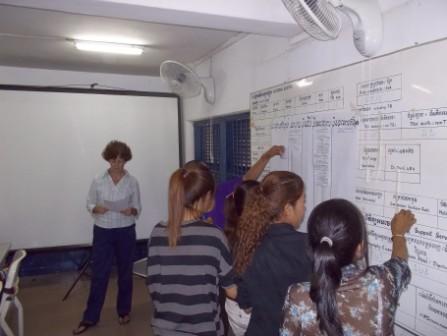
Women who attended the NGO Network meeting

Linda and Sue our friends celebrated in big style and went on a major adventure to visit some waterfalls near Laos on the motorbike.It was a long eventful day for them involving falling off the motorbike on three seperate occassions as the roads are brown loose dirt and full of holes and dips etc.

This is a photo of them calling in for the house key on their return to Treng, battered, bruised but not shaken.
Currently at the Orphanage I work at Solar power is being installed. We have two new volunteers from Germany here for 3 months , Marie and Sebastian.

This is a pic of Marie digging a trench to bury the water pipe taking water from the well to the water tower, tough work in the sun and 36 deg heat.
It was a public holiday so relaxing and a beer by the river in the evening with my female mates.

Saturday, 11 February 2012

Dusty roads and Health Centres


I am currently in the middle of a programme of midwifery skill drills for the Health centre Midwives.


Last Thursday, my VA Channa, and I set off by ferry to cross the Sekong and Mekong Rivers to Thala district at 7 am. We then had a one and a half hour motorbike journey North along rough brown roads to the Preah Romkel Health Centre on the West banks of the Mekong.


Three midwives were waiting for us and we set up our teaching session in the labour roomwhich has a beautiful view across the river.

First I tested them on the post partum haemorrhage drill they learnt last time – they remembered it very well. Next we went through breech birth with each midwife practicing the drill using the models sent out by kind people from the UK- Thank you again.


The midwives seem to enjoy this practical style of teaching- they say they have never learnt techniques to cope with problem breech births.


After the session we sat down to biscuits and a can of juice and now that they know me better they ask questions:

Can the soft lumps on a baby’s head at birth cause brain damage?

 Can I teach them how to suture after childbirth?

- I find this is a very positive step.


At midday we drove 3 Km further up the Mekong to the dolphin observation area but the dolphins were all a long way out or sleeping- not leaping out of the water in front of us anyway.

Next I was back on the motorbike for a further one and a half hours of potholes, dust and dodgy bridges.

We crossed back to Stung Treng on the ferry along with various livestock -this chicken had its legs tied together but kept flapping its wings too close to me for my liking.

I arrived home mid afternoon desperate for a shower and late siesta.